


Nigeria’s agriculture sector is the backbone of livelihoods for most of the country’s 200 million people, yet it sits within a paradox: it is one of the most invested-in and, at the same time, one of the most under-coordinated spaces in Nigeria’s development landscape. The binding constraint is not a shortage of programmes or funding, but a broken coordination architecture — the absence of coherent interaction between government Ministries, Departments and Agencies, development partners, and private sector actors operating across the same value chains.
The scale of the challenge underscores the point. The Malabo Montpellier Panel estimates that Africa needs $77 billion annually to achieve food systems transformation, a figure that only makes sense if actors work together rather than in parallel. What is missing is an agreed architecture: shared frameworks, coordinated mandates, aligned data systems, and governance structures that hold actors accountable across institutional boundaries.
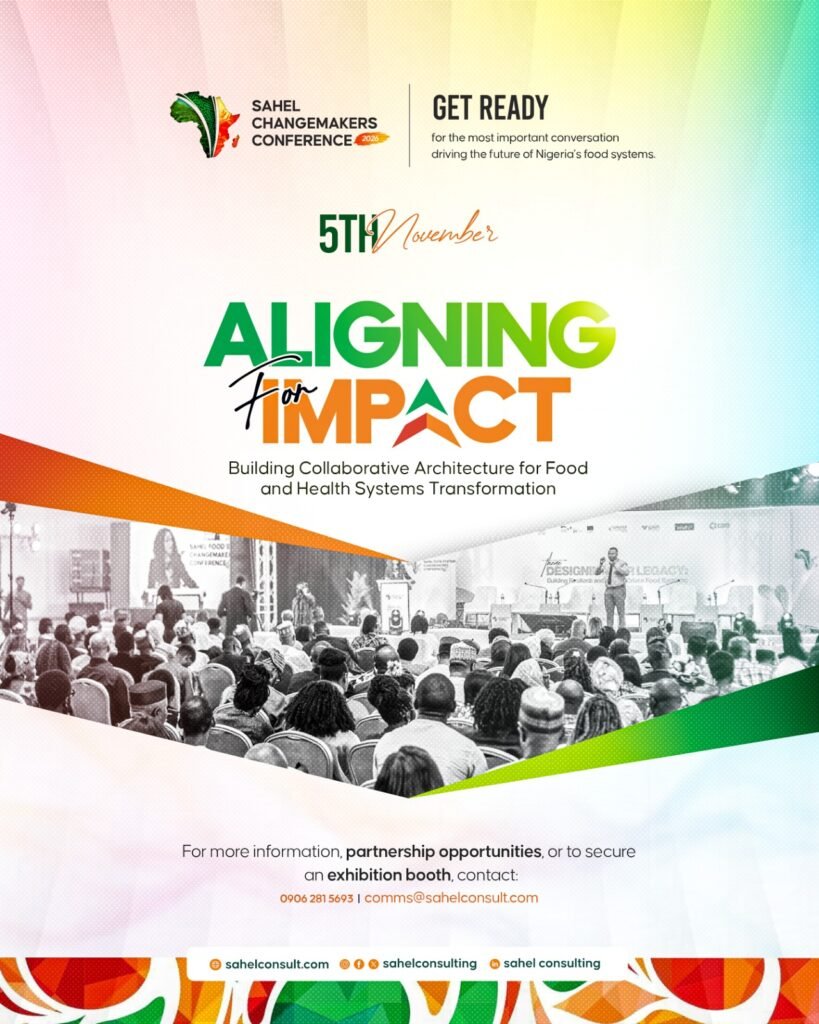
The 2026 Sahel Food Systems Changemakers Conference, themed Aligning for Impact: Building Collaborative Architecture for Food and Health Systems Transformation, builds directly on the 2025 theme, Designing for Legacy, by asking the follow-on question: what collective infrastructure is required to sustain that legacy? The answer rests on two interconnected imperatives — institutions that are empowered to lead, and a shared roadmap that aligns stakeholders around measurable progress. Drawing on four years of convening Nigeria’s most senior food systems actors, the 2026 edition moves from diagnosing the problem to designing the solution: the governance frameworks, digital coordination tools, and structured partnerships that make lasting transformation possible.
Objectives:
The 2026 conference is designed to produce tangible outputs. By its close, participants will have:
- Reviewed and validated Nigeria’s national digital coordination tools — including the Food Systems Dashboard, the NiMet MapRoom, and sector-level data platforms — producing a stakeholder-endorsed strengthening agenda and a shared action log for follow-through.
- Agreed on a set of institutional empowerment priorities — specific policy, financing, and accountability actions to be championed in the twelve months following the conference.
- Produced a widely distributed Conference Report that synthesises evidence, commitments, and the pathway forward, serving as a reference document for sector planning and donor programming.
- Strengthened the networks and relationships that make sustained coordination possible across government, development finance, private sector, and civil society.


REGISTRATION
Kindly secure your spot by filling out the form below
PAST SESSIONS IN 2025
Part 1
Part 4
Part 2
Part 5
Part 3
Part 6